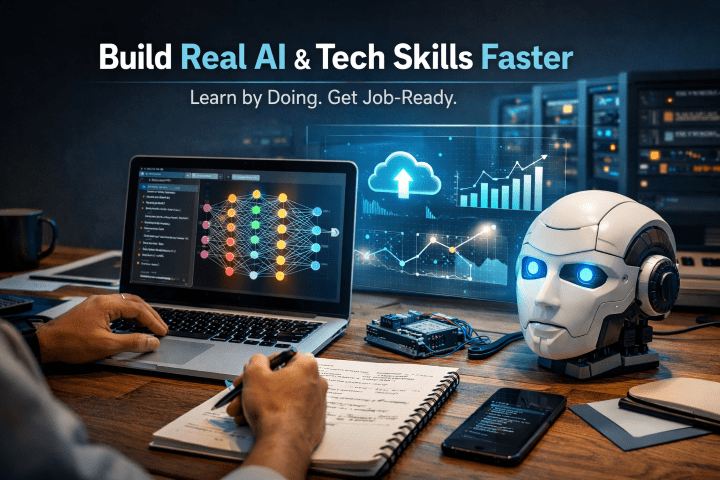
Why practical learning, not credentials alone, is becoming the new career insurance
The quiet reality many professionals are facing
Most professionals won’t say this out loud, but many are thinking it:
“I’m doing well right now—but will my skills still matter in two or three years?”
AI isn’t a future concept anymore. It’s embedded in hiring decisions, performance analytics, customer insights, forecasting, automation, and strategy. And it’s no longer confined to engineering teams.
What’s changing fastest isn’t job titles—it’s expectations.
Employers increasingly care less about where you learned and more about what you can do.
The real skills gap isn’t about intelligence
People often assume the skills gap exists because technology is “too complex.”
That’s not the real issue.
The real problem is that many learning paths:
- Focus on theory instead of application
- Require rigid schedules that don’t fit working professionals
- Teach tools in isolation from real business problems
As a result, people finish courses still unsure how to apply what they learned at work.
Knowledge without application doesn’t build confidence—and it doesn’t move careers forward.
What “real AI and tech skills” actually look like today
Real skills are not about memorizing definitions or frameworks.
They look more like this:
- Understanding how AI models are used in decision-making
- Working with data, even when it’s messy or incomplete
- Using programming or analytics tools to solve practical problems
- Collaborating effectively with technical teams
- Showing work through projects, not just listing courses
In short: skills you can demonstrate under real-world conditions.
That’s what employers are increasingly screening for.
Why hands-on learning changes the outcome
There’s a clear difference between watching someone explain a concept and actually doing the work yourself.
Hands-on learning forces you to:
- Make decisions without perfect information
- Debug mistakes instead of avoiding them
- Think in terms of outcomes, not instructions
This mirrors how work actually happens.
When learning environments reflect real-world complexity, professionals don’t just gain knowledge—they gain judgment. That’s where confidence comes from.
How Coursera approaches skill-building differently
Coursera’s model is built around one core idea:
learning should translate directly into workplace capability.
That’s why its programs are designed with:
- Industry experts and leading organizations
- Practical projects based on real job scenarios
- Tools and platforms used in modern teams
- Flexible, fully online formats for working professionals
Whether you’re learning AI fundamentals, machine learning, data analysis, programming, or cloud technologies, the emphasis stays the same: apply skills, don’t just study them.
From learning to leverage: what this enables professionally
For some professionals, these skills unlock promotions.
For others, they create optionality—the ability to move into new roles or industries without starting over.
And for many, the value is simpler but just as important:
- More confidence in technical conversations
- Better decision-making
- Reduced anxiety about automation and AI
Skill-building becomes less about fear and more about control.
Learning without burning out
One of the most overlooked advantages of modern online learning is flexibility.
You don’t need to pause your career or overhaul your schedule. Learning happens incrementally, on your terms, and often alongside real work.
That’s how skills actually stick—when they’re applied immediately, not stored away for “someday.”
Questions professionals often ask before committing
Is AI learning only for technical roles?
No. AI literacy is increasingly valuable across marketing, finance, operations, healthcare, and leadership roles.
Do online courses really help with career growth?
They do when they focus on practical skills, real projects, and credible credentials tied to industry needs.
How long does it take to become useful, not expert?
Often much sooner than expected. Practical competence develops far earlier than mastery.
A moment of honest self-assessment
Learning new skills is uncomfortable. There’s no way around that.
But the bigger risk today isn’t struggling through learning—it’s assuming current skills will remain sufficient by default.
Careers don’t stall overnight. They stagnate gradually, then suddenly.
Where to start building skills that actually matter
If you’re looking to build AI and tech skills that employers value—without stepping away from your career—this is a strong place to begin.
Coursera offers flexible, industry-aligned programs designed around real-world application, not just theory.
👉 Learn more here: Coursera
Final thought
Titles change. Tools evolve. Industries shift.
What stays relevant are skills you can apply, explain, and prove.
Building real AI and tech skills isn’t about chasing trends—it’s about staying capable in a changing professional landscape.
And that capability compounds faster than most people expect.
 𝑀𝓇𝓀𝒜𝓇𝒯𝒽𝐼𝓀𝒦𝓃
Leave a comment